![IncQuery logo 2022 (horizontal)-1.png]](https://www.incquery.com/hs-fs/hubfs/IncQuery%20logo%202022%20(horizontal)-1.png?height=39&name=IncQuery%20logo%202022%20(horizontal)-1.png)
A Choice-Based Conjoint analysis is used to determine the features of a product/services that customers prefer the most. Instead of just a traditional rating scale whereby respondents could rate everything as "most important", CBC Analysis gets the survey respondents to select a preferred product offering from (typically) among 2 or 3 concept configurations.
Here is an example of how a CBC question appears to respondents:
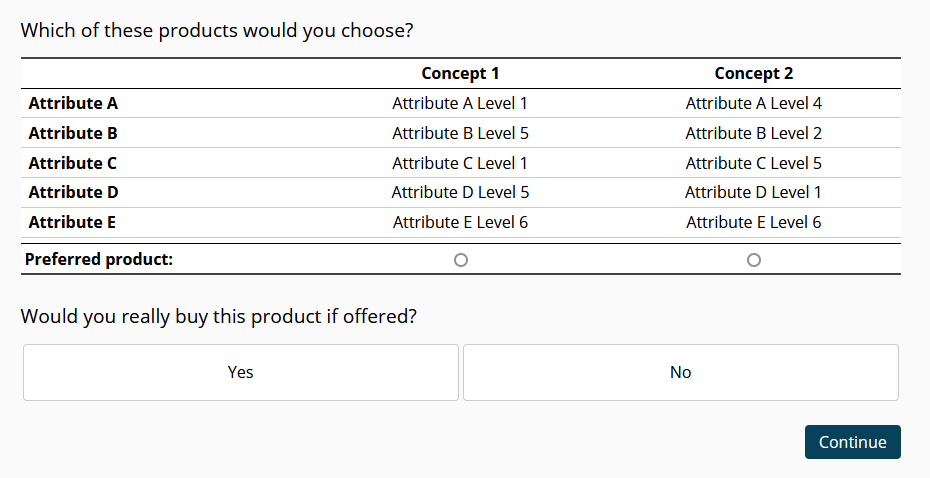 |
In this image we have two product configuration concepts made up of five attributes where each attribute has up to six levels.
Attributes can be any feature/aspect of your product or service such as price, duration, quality, speed, etc. While levels would represent the possible variations within each presented attribute. For example, a smartphone product concept could “memory size” as 1 of its attributes with corresponding levels consisting of “32GB”, “64GB” and “128GB”.
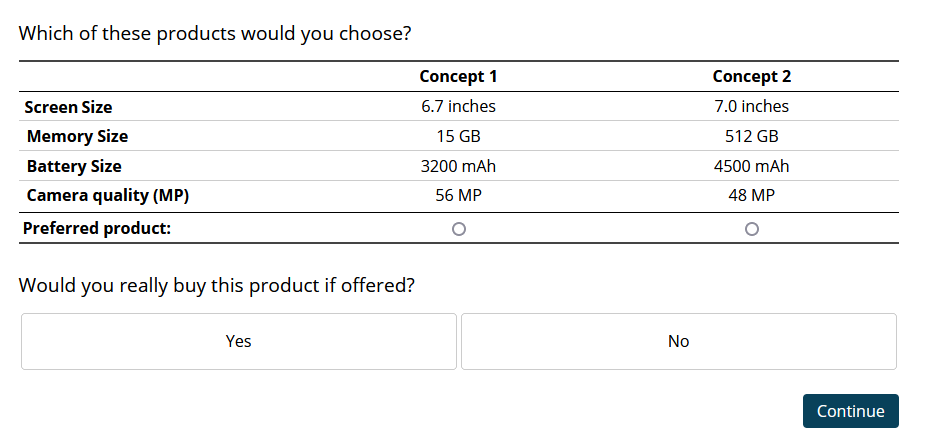 |
Product configurations can also be shown to the respondent in a limited set by looping the CBC question(s). This setup forces a respondent to evaluate trade-offs when selecting a product concept that they deem to be of higher value. From the selections made by the respondents, we can determine the relative value of each feature/attribute through further statistical analysis.
Setup
IncQuery makes the setup of a choice-based conjoint (CBC) easy. Work with your Survey Directors and they can insert the questions, variables, and logic needed for the conjoint to operate properly. Your team will fill in the attributes and levels and then send your design file (see below) to your IncQuery Survey Directors.
Design File
The design file is a critical element of setting up a CBC. This file describes how the attributes and levels are grouped in the various product concept configuration. This file is typically created by a statistician as the grouping of each product concept appearing in the CBC is important to the successful analysis of the data. If you do not have resources available to create a design file in your organization consult your IncQuery team for assistance.
Common Pitfalls
CBC analysis provides a robust ranking of criteria that is often better than typical ranking or scale questions, but the pitfall from CBC is the possibility of Survey fatigue. If you have a large number of product concepts the CDC question/loop will need to be run many times in order to get a proper data set. This looping on the same question can fatigue the respondent leading to low data quality.